Research

A New Service Strategy: How Police Staffing Studies Guide Smarter Fiscal and Policy Decisions. Government Finance Review, April, 39-44, 2026.

Police staffing studies can provide common ground for understanding the services a police agency must provide, how to deliver them most efficiently and effectively, the expectations of elected and appointed leaders, and how to align service levels with available resources. This article outlines what a best-practice workload-based staffing study entails, the data it requires, and how law enforcement agencies and government finance professionals can use its results. Read More

Read More

Financial Incentives for Recruitment and Retention: Views from the Field. The Florida Police Chief, Spring, 39-41, 2026.

We highlight how the practitioners rated 29 financial tactics for recruitment or retention. We view these through social exchange theory. Social exchange theory suggests that employees develop expectations of reciprocity in their relationship with employers, weighing the effort and risk they invest against the rewards, recognition, and support they receive. This may be particularly relevant for public safety settings, where the high-risk nature of the work can make perceptions of fairness, recognition, and organizational support especially consequential. Read More

Read More

Michigan State University Police Staffing Observatory: A Resource for Police Workforce Management. The Florida Police Chief, Spring, 35-36, 2026.

To assist agencies in navigating multifaceted workforce challenges, the Police Staffing Observatory (PSO) applies a systems approach to staffing, seeking holistic, long-term, and meaningful impacts. This article provides an introduction to the PSO and how it serves as a trusted resource for the law enforcement community. Read More

Read More

Tradeoffs of Lowering Minimum Education Requirements for Police Staff. Michigan State University Police Staffing Observatory, PSO Perspective, Vol. 3(1), 2026.

As staffing challenges persist, police agencies are lowering minimum education requirements to increase applications. Yet, as this PSO Perspective discusses, doing so has important benefits and drawbacks for staffing, community relations, officer professionalism, and performance. In turn, agencies must take these trade-offs into account as they navigate potential workforce solutions. Read More

Read More

Financial Incentives for Police Recruitment and Retention: An Examination of Perceived Effectiveness and Tradeoffs. Police Practice and Research: An International Journal, 2026.

Police agencies continually struggle to attract and retain officers. Social exchange theory, suggesting that employees develop expectations of reciprocity with employers, provides one lens to examine such efforts. This work assesses 29 financial tactics, identified through a systematic review of sources, that police agencies may use to recruit and retain officers. It reports practitioner perceptions regarding these tactics on workforce levels, Page 2 of 2 workload management, speed of impact, ease of implementation, agency costs, quality of police work, officer…

Read More

“You are Replaceable”: A Social Exchange Analysis of Correctional Officer Burnout and Attrition. Corrections: Policy, Practice and Research, 2026.

Correctional agencies face persistent staffing shortages and declining morale. This study analyzed over 600 Indeed.com employee reviews from officers across eight state Departments of Corrections to examine perceptions of the work environment using social exchange theory. Thematic analysis revealed recurring concerns about understaffing, mandatory overtime, low wages, and organizational neglect. Officers described emotional exhaustion, diminished trust in leadership, and a mismatch between job demands and institutional support. Perceived inequities in workplace exchanges contributed to burnout, disengagement, and turnover intentions. Findings…

Read More

Conceptualising and Defining the “Counterfeit” Chameleon. Journal of Economic Criminology, 2026

Product counterfeiting is a serious, global problem that is increasingly attracting the attention of academics, businesses, brand protection practitioners, law enforcement, and transnational organisations. Previous research found that consumers’ confusion over the definition of the “counterfeit” term fuels the illicit trade. This paper examines definitions published across a range of sectors and shows that there is little consensus as to the meaning of the “counterfeit” term. It has become chameleon term, appearing in different guises depending on the author’s purpose…

Read More

Brand Protection and Counterfeit Products: An Examination of Resourcing. Journal of Economic Criminology, 2025.

For firms operating in the global marketplace, effective brand protection is a critical defence against competitive risks. Firms allocate resources both internally and externally to protect their brand from the threat posed by counterfeit products. However, little is known about firms’ brand protection resourcing in general, and their reliance on external professional suppliers in particular. Drawing on prior research and interviews with anti-counterfeiting and brand protection practitioners representing 35 multi-national firms, this study provides actionable insights into the resourcing problem.…

Read More

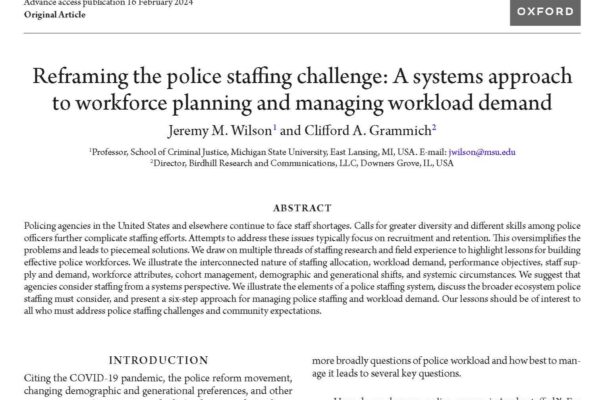
Adopting a Systems Approach to Police Staffing

It is often difficult for law enforcement workforce planners to systematically address allocation, recruitment, training, and retention to effectively address staffing challenges. Taking up these broaderdiscussions of police workload and how best to manage it, however, enables certain key questions to be posed, including the following:• How does an agency know when it is understaffed?• How does an agency address the effects of understaffing?• What can be done to build better workforces?• Are there solutions other than staffing for managing…

Read More

Dimensions of a Police Recruitment Program. Michigan State University Police Staffing Observatory, PSO Perspective, Vol. 2(3), 2025.

This PSO Perspective summarizes lessons from our research, Dimensions of a Police Recruitment Program, appearing in Policing: An International Journal, 2025. It identifies the key elements of police recruitment programs, supporting a more systematic approach to recruitment by reviewing academic and practitioner literature from 2010 to 2024 and conducting interviews with 26 subject-mater experts. Read More

Read More
Featured Research

Dimensions of a Police Recruitment Program

Policing: An International Journal

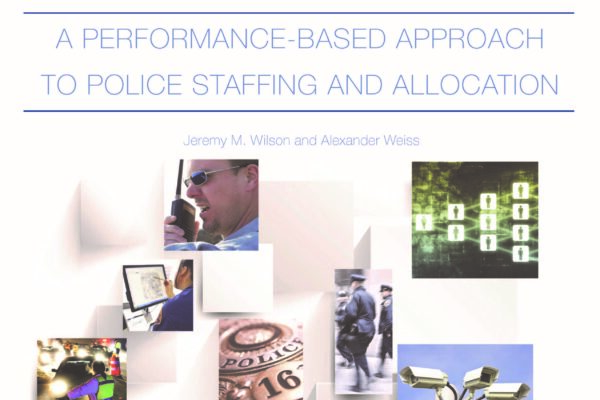
A Performance-Based Approach to Police Staffing and Allocation

U.S. Department of Justice, Office of Community Oriented Policing Services

Brand Protection and the Global Risk of Product Counterfeits: A Total Business Solution Approach

Edward Elgar Publishing

***WINNER OF THE AMERICAN SOCIETY OF CRIMINOLOGY DIVISION ON WHITE-COLLAR AND CORPORATE CRIME OUTSTANDING BOOK AWARD***

Police Recruitment and Selection: Resources And Lessons for Workforce Building

U.S. Department of Justice, Office of Community Oriented Policing Services