Research

“Options for Mitigating the Risk of Product Counterfeits: An Assessment of Lessons from Research and Practice” in Brand Protection and the Global Risk of Product Counterfeits: A Total Business Solution Approach.  Cheltenham, UK: Edward Elgar, 104-127, 2022.

Much academic research on product counterfeiting is disjointed and sporadic. It focuses on topics such as prevalence and not on tactics for reducing counterfeiting. Nevertheless, academic research on tactics can offer insights to practitioners. Such research is likely to be more independent, comprehensive, and rigorous than what researchers can do for themselves. This chapter reviews academic research on anti-counterfeiting tactics that businesses may use. It compares the distribution by category of such tactics with those that practitioners offer. While practitioner-suggested…

Read More

“Communicating the Value of Brand Protection through a Persuasive Internal Communications Approach” in Brand Protection and the Global Risk of Product Counterfeits: A Total Business Solution Approach.  Cheltenham, UK: Edward Elgar, 128-139, 2022.

Communicating internally about the important role of brand protection and what the enterprise must do to protect itself from counterfeits is one of the greatest challenges for brand protection programs. This chapter discusses the importance of using communication effectively to create an organizational culture that values and elevates brand protection across all levels of the organization. An analysis of organizational functions and tactics that brand protection experts recommend is reviewed using a persuasive communication lens. This chapter then offers suggestions…

Read More

“Counterfeiting and Anti-Counterfeiting Costs: An Application of Cost of Quality Concepts” in Brand Protection and the Global Risk of Product Counterfeits: A Total Business Solution Approach.  Cheltenham, UK: Edward Elgar, 141-158, 2022.

We apply concepts from the Cost of Quality (CoQ) literature to brand protection and product counterfeiting and use these concepts to provide insights into the nature of anti-counterfeiting investments and the returns to these investments. We start by describing the evolution of the CoQ model and contribute further to this model by incorporating additional cost characteristics. We then apply CoQ concepts to counterfeiting to better understand how firms can invest in anti-counterfeiting and dynamically assess their return to such investments.…

Read More

“Determining the Value of Brand Protection Programs: Identifying Metrics and Assessing ROI” in Brand Protection and the Global Risk of Product Counterfeits: A Total Business Solution Approach.  Cheltenham, UK: Edward Elgar, 188-207, 2022.

As brand owners deploy resources for brand protection, they seek to understand their return on investment and how to make their investments more effective. We investigate how firms measure their return on investment (ROI) in brand protection and consider alternatives to ROI that they might use. We interviewed brand protection professionals from ten firms in three broad industry categories: microelectronics and computer products; food, agricultural, and pharmaceutical products; and apparel, consumer, and luxury products. Because previous research on this topic…

Read More

“Implementation of a Total Business Solution for Brand Protection: Core Principles in Theory and Practice” in Brand Protection and the Global Risk of Product Counterfeits: A Total Business Solution Approach.  Cheltenham, UK: Edward Elgar, 248-267, 2022.

This chapter reviews the lessons that researchers and practitioners offer regarding the total business solution to brand protection. It revisits each of the six tenets: identifying the infringer as the unseen competitor; prioritizing prevention, proactivity, and strategy; integrating controls and mechanisms for detecting and responding to infringements; maximizing data, metrics, and analysis to assess and mitigate risk and gauge performance; formulating and executing a holistic approach that integrates and coordinates all parts of the firm for brand protection; and creating…

Read More

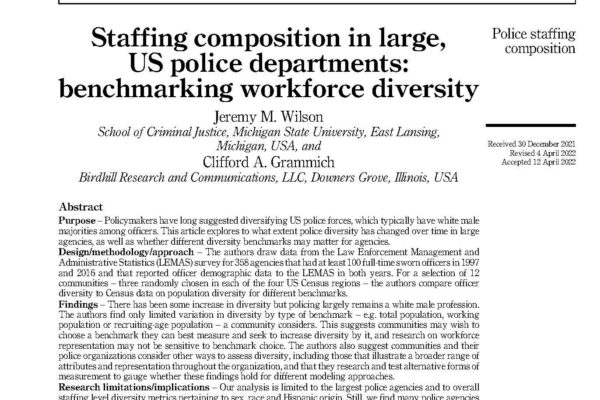
Staffing Composition in Large, US Police Departments: Benchmarking Workforce Diversity. Policing: An International Journal, Vol. 45(5): 707-726, 2022.

Purpose – Policymakers have long suggested diversifying US police forces, which typically have white male majorities among officers. This article explores to what extent police diversity has changed over time in large agencies, as well as whether different diversity benchmarks may matter for agencies.Design/methodology/approach – The authors draw data from the Law Enforcement Management andAdministrative Statistics (LEMAS) survey for 358 agencies that had at least 100 full-time sworn officers in 1997 and 2016 and that reported officer demographic data to…

Read More

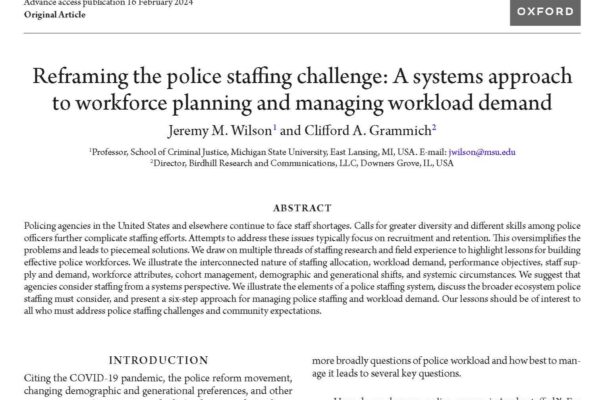
Reframing the Police Staffing Challenge: Strategies for Meeting Workload Demand. COPS Office Community Policing Dispatch, Vol. 15(1), 2022.

Police staffing challenges are both acute and systemic. Those seeking to address police staffing shortages, whether for one or many agencies, must ask, and have answered, some challenging questions about the actual work the agency needs to complete, its desired approach to accomplish it, and the extent to which it is doing so most efficiently. While personnel are critical to any organization, staff is only one way to address the workload of police agencies. This discussion has introduced some examples…

Read More

Protecting Brands from Counterfeiting Risks: Tactics of a Total Business Solution. Journal of Risk Research, Vol. 24(9): 1141-1160, 2021.

Firms may employ different approaches to protect their products. Previous research has typologized the tactics that firms might use in differing ways; among these have been tactics associated with individual products, those undertaken with partners, and whether a tactic is internally or externally focused. Yet there has been no systematic consideration of all the tactics firms might employ in protecting their brands. This research seeks to identify all the tactics that firms might use in a total business solution to…
Read More

Recruitment and Retention for Workforce Diversity. Washington, DC: U.S. Department of Justice, Office of Community Oriented Policing and International Association of Chiefs of Police, 2021.

The purpose of this guidebook is to provide the law enforcement field with information about existing resources for promoting workforce diversity through a variety of staffing mechanisms. More specifically, it focuses on creating a pipeline of officers, marketing, selection, staffing for recruitment, mentorship, organizational climate, career progression, analysis and benchmarking, and substantive focus on women and race/ethnicity. It is not meant to be exhaustive, but rather to promote awareness of research and professional publications that may not have been visible…

Read More

A Strategic Roadmap for Building Brand Protection Programs

This work seeks to help firms that wish to organize for brand protection: specifically, to combat product counterfeiting. It presents reasons why firms should organize and how they can do it. It provides an overview of product counterfeiting and how the problem has evolved. Importantly, it presents a framework for assessing the problem and discusses how to implement a total business solution to address it. Read More

Read More
Featured Research

Dimensions of a Police Recruitment Program

Policing: An International Journal

A Performance-Based Approach to Police Staffing and Allocation

U.S. Department of Justice, Office of Community Oriented Policing Services

Brand Protection and the Global Risk of Product Counterfeits: A Total Business Solution Approach

Edward Elgar Publishing

***WINNER OF THE AMERICAN SOCIETY OF CRIMINOLOGY DIVISION ON WHITE-COLLAR AND CORPORATE CRIME OUTSTANDING BOOK AWARD***

Police Recruitment and Selection: Resources And Lessons for Workforce Building

U.S. Department of Justice, Office of Community Oriented Policing Services